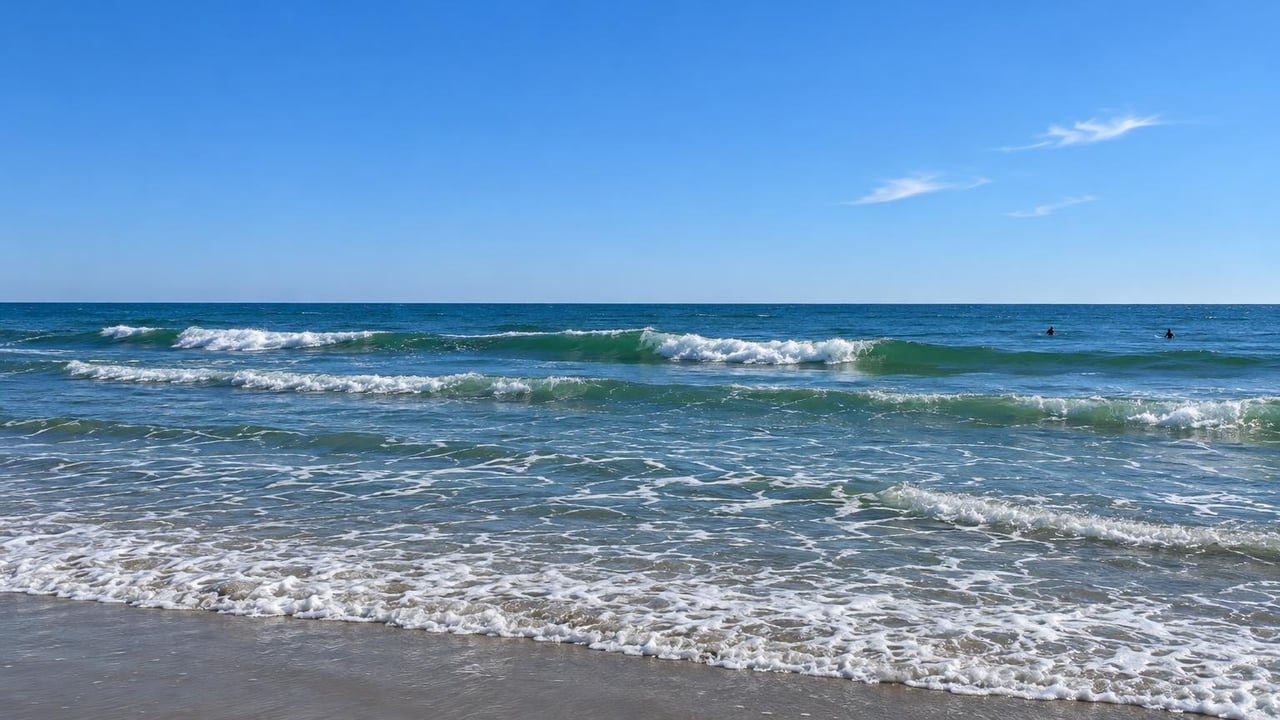
The beach gets quieter after Thanksgiving, and the Atlantic gets busier. December through February is the most consistent stretch of surf of the year in Cocoa Beach. Cold fronts push down the coast, the wind swings northeast, and waves that run waist-high to shoulder-high, sometimes bigger, show up more reliably than they do at any other time of year. Summer, the season most visitors picture, is the flattest. Long flat spells are normal, and the waves that do arrive are often too small to catch without a long, buoyant board.
There's a catch. The same front that sends the swell also brings the wind that can wreck it. On a winter morning in Cocoa Beach, the wind direction and the beach access you drive to count as much as the wave height. Get the wind and the access right and you'll have a good winter of surfing, and family visiting over the holidays can get a first lesson that goes well.
The front brings the swell and the chop together
Local instructors use the same four-part check every morning: swell size and direction, wind, tide, and crowd. Swell from the northeast and east lines up best on Cocoa Beach's sandbars. Wind from the northeast blows straight onshore and chops up the surface, while a light west or northwest wind smooths it. A winter front can deliver the swell and the bad wind on the same day. A forecast showing chest-high waves under a stiff northeast wind can still mean a messy session.
Tide is the third piece. An incoming tide puts more water over the sandbar and softens the shorebreak. A hard-falling tide makes it steeper. Time of day matters too. The wind is lightest before the sea breeze fills in, which is why lesson blocks start at 9 a.m.
The Florida Surf Museum's guide to the Space Coast describes the region's surf as fickle and dependent on wind. Its heavier days come from Atlantic systems with long fetch and from the occasional nor'easter. In practice, winter here gives you more surfable days than summer, but it doesn't give you a good wave every day. Check the wind first.
Water in the mid-60s
The ocean is a lot colder than the air this time of year. Florida Luxury Surfing's month-by-month guide puts Cocoa Beach water in the mid-60s from December through February, the coldest of the year, with air from the high 50s to the low 70s. Its instructors say a 3/2 wetsuit is comfortable in water in the 60s. Surf-Forecast's sea temperature page for Cocoa Beach Pier suggests a 2mm long-sleeve shorty or a 3/2 spring suit for windy February days. A January cold snap or a warm stretch can move the water several degrees either way.
If your guests aren't packing a wetsuit, Cocoa Beach Surf Company rents wetsuits and foam boards.
Picking the beach access for the day
Nearly every break in Cocoa Beach is a sandbar break, with no rock or coral underfoot. A beginner who falls lands in sand and shallow water. That's why Cocoa Beach suits a first lesson even in winter. What changes between beach accesses is crowding, shorebreak and current, and those differences grow when a winter swell is running.
Lori Wilson Park. This is the usual first-lesson pick. The Brevard County park has free parking, restrooms, outdoor showers, a dune boardwalk and lifeguards on the sand. The sandbars shift often, which keeps the waves crumbly and slow, and the inside section is soft. If you know Lori Wilson from our post on Cocoa Beach's dog-walking rules, this is the same county park.
Alan Shepard Park and the pier. Alan Shepard Park, at 299 East Cocoa Beach Causeway, and the water around the Westgate Cocoa Beach Pier are the busiest surf in town. The pilings create currents, the lineup fills up on a good swell, and the shorebreak can stand up steeply when there's size. SurfGuru's report for the pier describes an exposed sand-bottom break that works best on northeast to southeast swell with a west offshore wind. On a winter swell, the pier area is better for watching and for lunch after the session than for a beginner's first waves.
Robert P. Murkshe Memorial Park. South of the pier, the beach gets quieter. Murkshe is another Brevard County park with free parking. On holiday weekends and on solid winter swells, it's where a beginner lesson can find space. The wave is similar to Lori Wilson's, with shifting bars and soft whitewater on the inside. This is the beach to remember for the week between Christmas and New Year's.
Picnic Tables at 31st Street. This is the stretch for experienced surfers. The Dog Walker Surf Report's guide to south Cocoa Beach explains that this break sits beyond the shelter of Cape Canaveral, so it picks up more open-ocean swell and tends to produce better-shaped, more powerful waves than the breaks to the north. The same guide notes that the sandbars there shift often, rip currents form fast, and no lifeguards are stationed on that stretch. On a winter swell, Picnic Tables is for intermediate and advanced surfers. Visitors on their first day belong farther north.
Booking a lesson for holiday guests
Cocoa Beach has several surf schools at a range of prices, and winter lessons go ahead with wetsuits.
Ron Jon Surf School currently lists private lessons at $65 per person for one hour and $95 for two. Group lessons, where you're grouped with other students, are $50 for one hour and $75 for two. Equipment is included, the two-hour sessions depend on availability, and there's a $20 deposit per person.
Cocosol Surf Lessons lists private lessons from $75 per person and group lessons at $60 per person with a four-person minimum. Full gear is included. Children six and older can book.
Florida Luxury Surfing charges $99 for a one-hour private lesson and $169 for two hours. Kids' lessons and family or group lessons are $99 for one hour and $129 for two, and kids' lessons start at age six. Its lessons run daily from 9 a.m. to 5 p.m. A wetsuit comes with every winter lesson. If a strong front comes through, the school may move a beginner session back a day or two. Its instructors also choose the beach access on the morning of each lesson, based on swell, wind, tide and crowds, and the confirmation names the access point.
Those prices were current when we published, and schools change them, so confirm when you book. For holiday visits, two details matter more than price. Book for a morning, and schedule the lesson early in the visit so a front has room to push it back.
The sand those sandbars sit on
The beach your guests learn on was partly rebuilt recently. The Canaveral Harbor sand bypass moved about 1.5 million cubic yards of sand from north of Port Canaveral onto eroded shoreline in Cape Canaveral and Cocoa Beach. In August 2025, the U.S. Army Corps of Engineers described the project as completed. Port Canaveral's January 2025 announcement put the southern placement from near North 2nd Street south to Tables Beach. Pumping ended May 3, 2025.
For this winter, Brevard County's beach management page says no restoration is expected in 2026 in the North and Mid Reach, the stretches that include Cocoa Beach. The county's next shore protection work is the South Reach, from Indialantic down to Spessard Holland Park in Melbourne Beach.
Cocoa Beach surfers have long watched how sand placement changes the bars. A piece on Dan Reiter's site, "What happened to the sandbars?", covers the 2001 and 2005 renourishments. It reports on a dissertation by John Hearin, then vice-chairman of the Cocoa Beach Surfrider chapter, which found those projects turned Cocoa Beach into a tide-dependent surf zone with a narrower break and more closeouts. That history is one reason locals check the tide as closely as the swell.
Saturday, Dec. 12, at Alan Shepard Park
The best way to see winter surfing done well is to watch it. The City of Cocoa Beach calendar lists an Eastern Surfing Association contest at Alan Shepard Park on Saturday, Dec. 12, 2026, from 8 a.m. to 5 p.m. It's an easy morning on the sand with visiting family, and with the pier nearby, lunch is a short walk away. Twelve days later, on Christmas Eve, comes Surfing Santas, which we covered in our guide to Cocoa Beach's December.
If winter mornings at Lori Wilson or Murkshe have you thinking about living closer to a beach access you love, or wondering what your own place near the water would bring, the Beach Life 321 Team is a call away. Start with a free home valuation, and we'll talk through the rest whenever the waves allow.