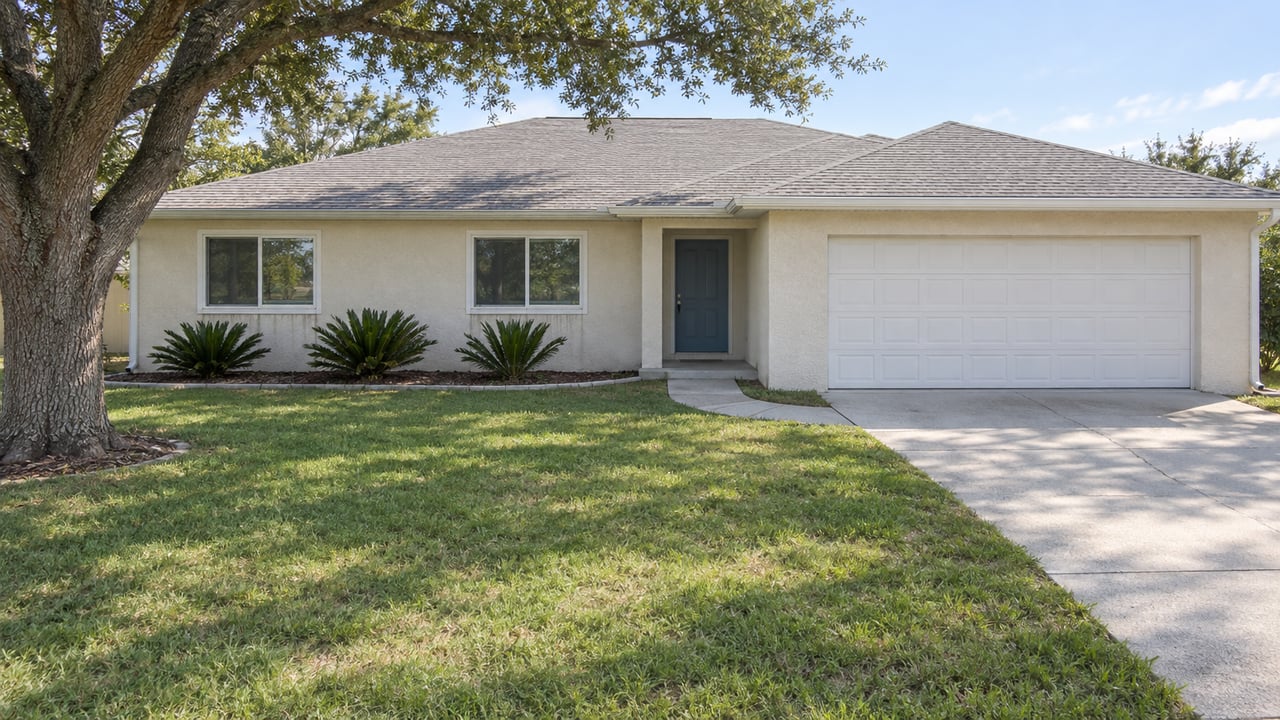
Last fall, a Brevard County environmental specialist showed a lagoon oversight committee two Merritt Island houses that sat side by side. One sent an estimated 27 pounds of nitrogen into the Indian River Lagoon each year and qualified for the county's full $20,000 septic upgrade grant. The house next door was estimated at three pounds and qualified for about $2,500. Central Florida Public Media reported what the specialist, Joel Beaudry, told the committee: "To the neighborhood, all the houses look the same. All the houses are near the lagoon, and all houses have that mandate to upgrade as per that new state rule."
That example shows how septic works on Merritt Island right now. Every septic home has the same state obligation, but the cost to each owner is set parcel by parcel. If you're comparing two Merritt Island houses with similar prices, the septic line can separate them by thousands of dollars, and neither listing shows it.
The obligation is identical on every septic lot
Florida's Indian River Lagoon Protection Program covers the Banana River Lagoon, Central Indian River Lagoon and North Indian River Lagoon plan areas, along with the Mosquito Lagoon area. Inside those areas, the statute says that by July 1, 2030, any residential property of 10 acres or less with an existing septic system must connect to central sewer if it is available. If it isn't, the owner must upgrade to an enhanced nutrient-reducing system or another system that removes at least 65 percent of the nitrogen. That wording comes from the 2026 amendment to section 373.469, which the governor approved on March 19, 2026. It kept the 2030 date in place.
Two more details in the law matter for anyone buying a septic home. Since January 1, 2024, a new septic system in these areas must be nitrogen-reducing, whatever the lot size, wherever sewer isn't available. And when an owner applies for a permit to repair, modify or replace a conventional system before the deadline, the permitting agency has to notify them of the 2030 requirement. Florida DEP's guidance page lists the approved technologies: in-ground nitrogen-reducing biofilters, NSF 245-certified aerobic treatment units and approved performance-based systems.
From a closing in mid-November 2026, the deadline is about three years and seven and a half months away. If you buy a septic home on Merritt Island this winter, you will very likely be the owner who has to meet it.
The help is calculated house by house
The cost isn't uniform because Brevard's Save Our Indian River Lagoon program has awarded upgrade grants based on a model of how much nitrogen each property sends to the lagoon. The grant follows that estimate.
Meanwhile, upgrades have become more expensive. County staff put the average Brevard septic upgrade at $18,000 in 2020 and more than $22,000 by late 2025. In December 2025, county commissioners unanimously set a $6,000 minimum grant for eligible applicants as a one-year trial. Today, Save Our Lagoon's upgrade page lists eligible grants from a $6,000 minimum to a $20,000 maximum. It also says retroactive reimbursements for upgrades finished before an application were approved in December 2025 and capped at $6,000.
At the oversight committee's August 2026 meeting, staff reported that in the pilot's first eight months, 44 projects had used the $6,000 minimum. That was about 16 percent of completions, compared with about 6 percent at that level before the pilot. The committee voted unanimously to continue the pilot for another year and keep evaluating it against state actions.
The minimum narrows the gap between neighbors but doesn't close it. With a $22,000 average cost, an owner whose parcel qualifies for the minimum pays roughly $16,000 out of pocket, while one whose parcel qualifies for the full $20,000 pays roughly $2,000. That's a planning estimate built from county averages, and actual quotes vary by site.
Whether sewer reaches your street changes the math
The grant amount is only half of the calculation. The statute says "connect to central sewer if available," so a home inside a county sewer project faces a different decision from one that will stay on septic.
Here is where the Merritt Island-area sewer projects stood in the county's fall 2026 updates:
Project area | Status | Source date |
|---|---|---|
Merritt Island Zones C and F | Design complete; going out to bid together with South Banana B | Sept. 1 and Aug. 2026 |
Merritt Island Zone G | In design | Sept. 1, 2026 |
North Merritt Island Zone E | Preparing permit package | Oct. 2026 |
Sykes Creek Zone N | Vacuum pump station walls poured; 75% of sewer pipe installed | Oct. 2026 |
Sykes Creek Zone T | Vacuum pump station electrical and mechanical work underway | Oct. 2026 |
Sykes Creek Zone M | Under construction | Sept. 2026 |
Project boundaries can also grow. The oversight committee unanimously approved expanding the Sykes Zone N project to nine more lots on the adjoining Coral Street.
The county estimates that construction takes 10 to 18 months once a project is designed and permitted. Before that, design alone takes about 18 months.
The type of sewer matters too. Save Our Lagoon's homeowner guidance says connections to gravity and vacuum sewer are mandatory in many cases, while connecting a single-family home to a forcemain is optional. Sykes Creek Zones N and T are both being built with vacuum pump stations.
Homes that already sit near a sewer line have a separate path. The county identified 4,496 properties within 30 feet of existing sewer and funded "quick connects" for the 876 that load the most nitrogen. Those grants are calculated at $1,600 per pound of estimated nitrogen reduction. They're capped at $24,000 for force-main or pumped gravity connections and $12,000 for gravity connections without a pump. In County Utility Services territory, the connection fee comes out of the grant. The county doesn't post a residential connection fee. It asks owners to request one from Utility Services.
Connecting to sewer also adds a monthly bill. Brevard County posts three residential sewer rate classes, reflecting a 7.5 percent increase on bills issued from February 1, 2026. The Resident A rate is a $32.79 monthly base charge plus $6.93 per 1,000 gallons, with billing capped at 12,000 gallons. At that rate, a household using 5,000 gallons a month would pay about $67 for sewer, and the county's rate page lists the other classes. An upgraded septic system has its own ongoing cost: state law requires maintenance on aerobic treatment units. In-ground biofilters don't carry that requirement.
Two houses with the same price can therefore land in different places. One may get a grant-funded sewer hookup, another a hookup with little help, a third a septic upgrade with a $20,000 grant, and a fourth an upgrade at the $6,000 minimum.
Where the backlog meets a closing timeline
Timing is where this rule causes trouble in a sale. Owners must get approval and a notice to proceed from the county before starting grant-funded upgrade work. At the August 2026 committee meeting, county staff reported that several installers were in their busiest period ever, that Florida Department of Health permitting was running about 90 days, and that contractors from neighboring counties were entering the Brevard market.
A typical contract period is shorter than that permitting window. A seller who decides to upgrade before listing is starting a process that can easily outlast a 30- or 45-day escrow. Doing the work after the sale moves the grant application, contractor search and permit wait to the buyer. Grants are paid after the work passes Department of Health inspection, and any cost above the approved grant stays with the owner.
Florida Realtors published guidance in September 2026. It encourages sellers to disclose known septic service history, affected-area status and notices, and it encourages buyers to check permits, maintenance records and sewer availability during due diligence.
The money behind the grants has its own calendar
The grants have a funding source with an end date. Brevard's septic upgrade and septic-to-sewer grants are paid for by the Save Our Indian River Lagoon half-cent sales tax, with some state and federal money added. Voters approved the tax in 2016, and the current levy runs through December 31, 2026. On May 19, 2026, commissioners voted unanimously to send a 10-year renewal to the November 3 ballot. Central Florida Public Media explained that without renewal, already-planned projects would continue until their funding runs out, but no new revenue would be collected for additional projects. The state deadline, by contrast, is written into law with no expiration.
Questions to settle before you write an offer
- Is the home on septic or sewer, and are there permits and maintenance records for the current system?
- Is the address inside a planned or active sewer project, and what type of sewer is planned? The county's Sewer Projects page and Utility Services can confirm.
- What grant amount does the county's map show for this parcel, compared with a neighboring home you're also considering?
- Has the system already been upgraded, and was it reimbursed?
- If a connection is possible, what connection fee does Utility Services quote?
- Can your contract timeline absorb a permit wait of about 90 days if work is needed?
This post is general information, not legal, tax or financial advice. Confirm your own property's obligations and options with Brevard County, a licensed septic contractor and your attorney or lender.
FAQ
Does a house that already has a nitrogen-reducing system still need to do anything? A system that meets the 65 percent nitrogen-reduction standard satisfies the upgrade path in the statute. If it's an aerobic treatment unit, state law requires ongoing maintenance.
Where can I check a specific address? Save Our Lagoon at (321) 633-2016 or [email protected], and the homeowner grants page.
Can I pick my own contractor? Yes. The county says owners can choose any licensed contractor, and it recommends getting several estimates.
If you own a septic home on Merritt Island and want to know how its sewer zone and grant status could affect your sale price and timeline, the Beach Life 321 Team can include them in a free home valuation, so you'll know your septic numbers before a buyer asks for them.